Showing posts with label Critical Thinking. Show all posts

Friday, December 15, 2017

Learning The Most Important Learning Skill: Learning On Your Own

KJ watching another kid play a Grand Champion Chess Player
Self-Sufficiency- I've harped on this a million times because it is a key component of a happy life and an enabling factor for a strong society.  It's so important that it has a formal place in our HomeSchool Charter. One of the keys to Self-Sufficiency is being able to learn things on your own.  Sure, I could distill and dispense information all day long and have the girls simply learn that way, but I will not always be there and I certainly don't know everything.

Further, as humankind evolves, there will be new frontiers where there is no established textbook or knowledge base and those that will thrive will be those that can teach themselves these emerging areas.  I'm giving my girls a HUGE advantage over others by emphasizing the self-learning skill.  Being able to do this was a huge part of my professional success: I could teach myself the most bleeding edge technologies before they ever appeared in common communication channels (when everyone else could catch up), and by the time they did emerge I was already known as the expert and even quoted in common press articles and books (I've even had chapters in books devoted to what I did!)

To help build the "Learn on your own" self-sufficiency skill, I gave KJ a choice of a Strategy Game that she would have to learn on her own.  The choices were Go, Poker, and Chess.  She would have to join a league, and I would determine her "grade" based on how well she did in the league.  Neither her mom nor I would help her, she was on her own (beyond approving of online account type stuff).

KJ selected chess, and started her journey.  She found all her own resources (websites, videos, and even an online chess learning "freemium" platform called ChessKid).

Here are a couple of things that have emerged, beyond her simply learning chess:

  • In the beginning, we would overhear KJ sharing with her little sister,Dy, what she learned. This dialog spawned lots of neat side-effects- KJ could ensure she understood finer points, KJ gained places of further inquiry as some of Dy's questions she didn't know the answer to, Dy picked up the rules of the game, the girls had talking points that were not superficial 
  • The competitive aspect of chess has served as a neat way to goad KJ further, as she hates to loose, even to a "robot." So she works her knowledge and even more importantly, thinks about strategy application (yeah! more strategy!!!)
The hardest part has been keeping the wife component from "Helping" :) That motherly instinct is strong!!! But the Wifie understands that the goal really isn't mastery of chess, but mastery of learning how to learn on your own.


Friday, December 1, 2017

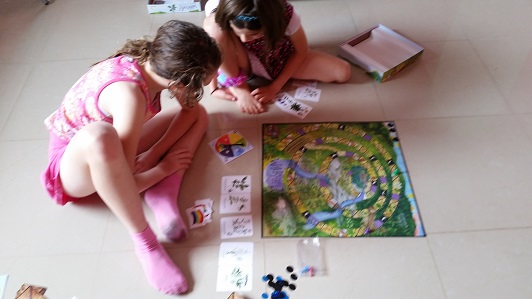
Wildcraft Game Review - A So-So Cooperative Family Game For Learning Strategy

Our oldest, KJ, loves to study the medicinal uses of plants.  It's not my thing, but it is hers.  Maybe someday she will become some sort of pharmacologist spelunking the wilds of the Amazon to find rare and unique plants that could cure cancer.  Who knows!?

So, anyway, while reading posts on a homeschool forum, I saw a number of posts about a game wherein you collect plants to solve various maladies!  HOW DAMN COOL!!! I couldn't wait to order the game, it is called Wildcraft.  (Wildcrafting happens to be the name of foraging wild plants to help with various physical issues or for food).

As is our approach to all new games, each of us read the instructions on our own.  We got together to have a discussion of the rules and make any aggreements or clairifications before we start.  We found the rules to be VERY simple and we were able to get into game play very fast.  As a side note, I particularly enjoyed the family friendly tone and nature of the instructions, along with how the was created.... which was by a family!  It make it feel more genuine to us all, knowing that another family made the game and is seeing success selling it.
The layout of the game is simple, with near zero set up time.  All you have to do is create a pile of tokens, segment the cards, unfold the board, and viola, you're into game play mode.

The game is listed as a cooperative board game.  As a family that plays a lot of games, we love these kinds of games as the mission is all about all of us succeeding together.  It becomes a nice joint mission.

At a macro level, the goal of the game is to get up the mountain, collect some berries, and return to grandma before it's dark.  Alas, you do get some bumps and bruises (and other ailments) along the way that require your skill as a Wildcrafter to handle.  For a basic ailment, like being tired, you (or another member of the party) need to have collected a plant to resolve that issue. The plant is represented by a card, so either you have the card of the planted needed or you don't.  The pictures of the plants on the ailment cards are very helpful.

It doesn't take long, however, to realize that the game is tremendously chance driven.  There really isn't a whole lot of "strategy" thinking.  That is, choices really don't have a huge impact either way and smart choices actually have negligible impact in the game. The creators of the game made it clear in the instructions that really the rules are guidelines and that they expect people to morph and modify as they go.  We've begun experimenting with rule tweaking to help make the game involve more decision making versus blind luck.

As game playing adults, the game is neat the first go around, but after that it is kind of lame.  Our daughters, however, enjoy playing the game and pull it out on their own to play. (the pictures in this post were taken on a Sunday afternoon when they did just this).

As far as ages go, a 7 year old could do this.  I suspect that many boys would find the game too girly to keep their interest.

If you want to teach strategy, I would not recommend this game.  If you want to learn about the basic uses of some plants, then maybe (the biggest common online criticism of the game is that while the game tells you which plant(s) solve an ailment, it does not say what part of the plant to use nor how it should be prepared).  If you have some daughters that like plants and flowers and picking berries and the notion of hiking up a mountain to pick berries for Grandma, then this game is a winner!

Saturday, July 15, 2017

Forbidden Island Game Review - Great Cooperative Family Game For Learning Strategy


For Christmas 2016, our family purchased a game for the mom component called Forbidden Island.  It has been over 6 months since we started playing it, and it is still the family favorite game.

The basic premise of Forbidden Island is that you and your team-mates have landed on an island that starts to sink, and you and all the team mates have to make it off the island with all the treasures before it is fully submerged to win.

While the rules make total sense now, and are well written, it took us 3 tries (full game plays) to finally get it right.  For example, we were making a mistake about what to do when a part of the island submerges with a player standing on it.  We wrongly played it as, "ooops, you're dead ... we all lose."  This is wrong as the game is clear that you can simply swim to another part.  I guess if we got super awesome at the game, we could make this a "you die" rule to make it more challenging.

The game play actively encourages dialog/table-talk among the players as it unfolds yielding an obvious benefit, then a not so obvious benefit.

Like a real life team, you have to figure out how to work together to pull off the task.  The talking  creates an awesome education opportunity as we discuss the trade-offs, risks, merits, etc. of various approaches during each turn.  After just a few games, I could clearly see the wheels turning in my daughters as they thought through the possible step/game play sequences.  Further, their articulation of why certain approaches may be better has improved too.  This dialog has also another interesting, unexpected, learning opportunity: analysis paralysis.  Our girls can now see so many paths and make so many good arguments for what approach to take as we play that we can simply get too deep into the analysis and be paralyzed.  This has happened a number of times allowing us to discuss the perils of too much too deep and simply not making a choice.

The game is set up such that each player has distinct abilities, which are randomly assigned via player cards, and not all of the abilities are available from game to game.  This particular variable, the
shifting and variance of the ability collection from game to game, helps ensure different approaches to winning are taken each time you play.  This alone gets the girls excited as they wonder which abilities they will get from game to game.

There are so many things that I personally like about the game, such as the names of the island parts (like Bridge of Abandon and Phantom Rock) and the gorgeous/mystical graphic, but I most appreciate is how clever the game flow and rules fit together to create the challenge.  Things get hard at the right times.  Brilliant. Brilliant. Brilliant.

Our 8 year old studying
the rules of Forbidden Island
The game makers suggest ages 10 and up, but our 8 year old does just fine.  Keep in mind, though, she has been playing board strategy games since she was 5.

The difficulty in playing this game is one notch above Monopoly, but two notches below Carcassonne.  Most of our games end in 40 minutes, but could be 20 minutes if we didn't discuss so much! :)

Monday, May 1, 2017

War's Gift To Kids- Learning How To Apply Strategy Through Games

Our 8 year old playing a phenominal cooperative
family game called Forbidden Island where choices
are openly discussed and applied, fitting into
an overall shared strategy.
All parents, homeschooling or otherwise, expect their children to make good choices, but I've never met another parent that teaches the mechanics of how to do this.  Primarily they expect their kids to kind of figure it out through trial and error.  I've over heard some parents say things like "Think about the consequences" but that's the extent of their advice.  There is a whole academic discipline devoted to making good choices and it is called "Strategy."

Many people simply brush off studying Strategy as a war thing.  While it does have its roots in the unknown and chaotic environment of warfare, over the years its application to all areas of life have been studied and applied to great effect, be it business, or home buying, or simply picking out where to hold a party (we did this as part of a course at Stanford on Strategy).  Unknowns and chaos are a part of life and having the ability to formalize decisions in such spaces is a very powerful tool.  Even when to be spontaneous can be analyzed as part of a strategic decision.

Learning about, and applying, Strategic Thought in life is an important part of our Homeschool education.  Strategic Thought enables our girls to make better choices in uncertain and unknown environments, which covers a large swath of actual life .... and an even larger amount if you push yourself into unknown areas. We feel so strongly about this that we've not only formally codified it into our homeschool charter (VI. Strategy of Exerevno Academy.2, VII.Tactics of Exerevno Academy.4, and VIII.Operations of Exerevno Academy.3), but we actively pursue it as a field of study on its own.  We leverage board-games as a laboratory for this topic, and life's choices for the actual application.

The kinds of Board-Games we incorporate in our homeschool life for strategy lessons are turn based, where the pace of the game is regulated by our choice speed.  Our board games are chosen such that neither physical agility nor physical prowess grants an advantage.  What matters is the ability to make good choices.  No, these aren't all war games.  In fact, as I look at our game collection, of the 30 some games in it, only two are explicitly/overtly about war (Stratego and Risk) and two are implicit (Go and Chess).

Some games we play are cooperative, while others are adversarial.  Some are team based, and some are each man for themselves.  Some are perfect information games, while others are not.  Some are 1 player, some 2, some 4, some 6 and up.  The games have various age recommendations, from 5 and up to 13 and up (although we consciously ignore the suggested age range). Some take 5 minutes (Uno, for example), some have taken 5 hours (we once played Carcassonne Big Box and it took 5 hours for a single game), and some take days (Monopoly seems to have this happen more than most games). Some have elements of chance and some require diplomacy, but all require strategy.

These kinds of games also provide for another important part of our homeschool approach, the acquisition of the skill of active feedback (again, see our charter).  You can see and measure how outcomes are unfolding, and because we use turns as a speed regulation mechanism, each person can operate their feedback loops comfortably and adjust if need be.

If you're homeschooling, you probably include games to some degree but do you activity choose, study, and play games that develop specific deep skill sets you want your kids to have in life?  We do, and our girls LOVE them.  We will be sharing examples throughout the life of this blog, and they will be labeled with Games.

Do you have a great strategy board game recommendation? If so, please do share.

Tuesday, December 20, 2016

Present Choices Activity

Here we are, a few days before Christmas. Presents under the tree, all looking seductive.  This gave rise to a fasctinating discussion around choices, mathematics, pragmatism and more.  Like so many of the good activities, this one evolved organically.

"Dad, can we open a present early?" - Dy (my youngest who is 8)

"Well, let's talk about this. I might be open to it.  Imagine if I gave you two options.
Option 1: You can open one present
Option 2: You can flip a coin, and if it is tails... you get zero presents, but if it is heads, you get two presents
Which option would you pick?" - Dad

--- Nice Long Pause --- The kind that shows the wheels turning in the mind

"Dad, I'd take option 1"  - Dy

A great 30 minute discussion then ensued by me changing the parameters.  For example:

"Dy, well how many presents would it take before you'd take option 2?"

and

"Dy, what if we used a dice instead and if you got an even number, no gifts... but if you get odd, you get two gifts?"

and

"Dy, what if we used a dice, and if you got a 1 or 2, no gifts, but if you get a 3 or higher, you get that many gifts"

and

"Dy, would it make a difference if we did this kind of deal 1 day before we normally open presents, or 5 days before we normally open presents?"

and

"Dy, would it matter if I get to pick the presents you choose from or if you do?"

and so on and so on.

As she would make a selection, we would talk about her reasons, the payoffs, the risks and more.  We then flipped it, and I asked her to offer me some version of the deal.  It was a very real feeling exercise because there were in fact real presents under the tree and she knew that whatever we settled on would indeed be offered up.

In our family, we've decided that the day before we normally open the gifts our girls will indeed be offered a deal.  It will be as follows:
Option 1: You get to pick one present from any of the presents with your name on it
Option 2: You flip a coin, and if it is tails you get nothing, but if you get heads, you get three of them

ho Ho HO!